

I met her again recently. I don’t think of her as a specific individual, but rather as a template. A template of the mind. A single exchange of glances was enough; we both knew that words were practically unnecessary. We use them, however, because such are the customs here.
She avoids eye contact even more than I do. Yet, I don’t sense fear in this behavior—rather, a polite concern for us both. It is as if by limiting her gaze, she wants to spare me the discomfort of exposure, and herself unnecessary impressions. Spilling energy left and right is unwise.
I see now that I was wrong to mistake the economy of her gaze for fear. Her roots, after all, reach much deeper than mine. I was right to believe that the economy of looking does not stem from fear, but from strength.
I have no trouble looking into the eyes of people I dislike. I have no trouble meeting a gaze if I hate someone.
The trouble arises, however, when looking into the eyes of people who have unclean intentions toward me, yet stir a thread of sympathy within me. They may not know it, but I sense the scent of their thoughts like a hound on a fox’s trail. They are no mystery to me. Neither is their behavior, nor their intentions. I allow them their foul play. I observe. I watch what they are capable of in the pursuit of their own lusts. I see that they are like children—troublesome, wayward, but in the end, it’s only about getting mother’s attention. Or maybe some candy?
Playing the victim is an extreme sport, but not because of physical danger. People are rarely dangerous. The greatest threat is that, over time, one becomes saturated with this disease, and an ordinary, simple life becomes devoid of thrills and color. It is like a drug that acts only on the mind.
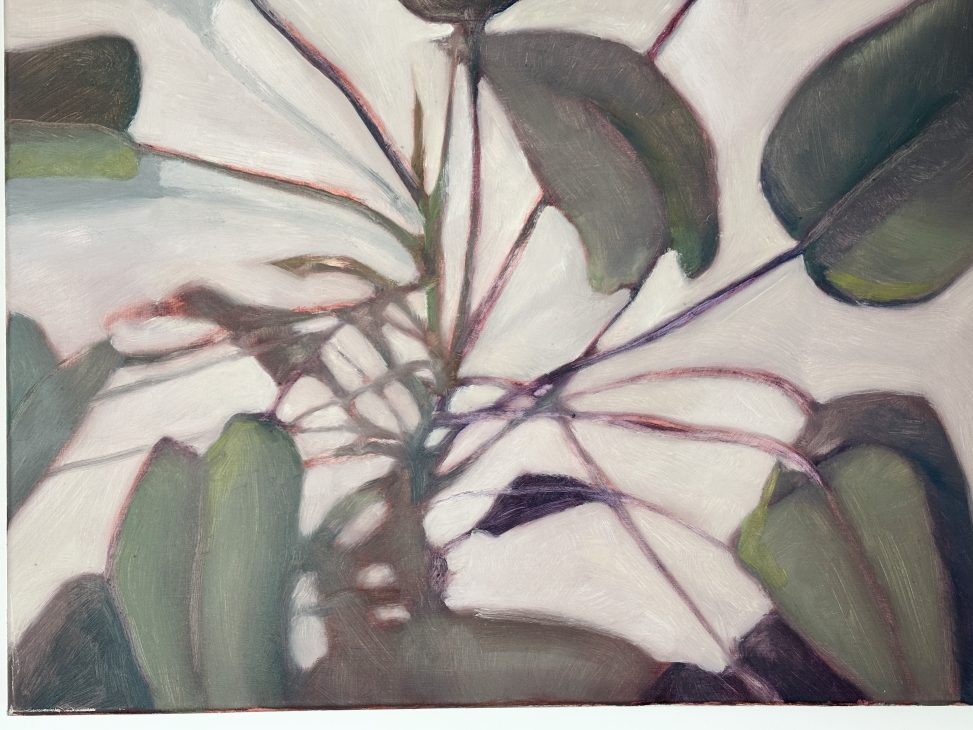
Meditations on a Monstera plant, 50x80cm, oil on canvas, 2026