

I am riding my bike through the forest. The path is good but rarely used. I am alone. It is very warm. I won’t push myself today; I’ll do a standard route, twenty-some kilometers.
I turn off the gravel road onto a forest trail. Few people come here, though the lake is close. Few people come here because to do so, one must like to wander. And wanderers are relatively rare. Occasionally, I pass someone on horseback. Today, however, there are no wanderers. It is empty, sunny, dry. Perfect.
I often find myself stopping suddenly. I brake hard, for my pace is fast. My eye registers an object faster than my brain: a feather, an eggshell, bones. Sometimes I am standing still before I even understand what I am looking at. Only when I back up does the image of what I saw in flight appear in my mind. Over the years, I have truly developed a gaze. My trips are a scanning of the terrain.
Today, I found a thrush eggshell and a few jay feathers.
Now, however, I stop for a different reason. I am drawn by a sweet, intoxicating, and very intense scent.
The scent of decay
It heralds a swift find, though likely in a state unfit for taking. It doesn’t smell strong enough to be a large animal, but enough not to ride past. Nothing is visible on the roadsides yet. I park my bike. I know I will spend a moment here and I do not want to be disturbed.
I sniff the air like a dog. This is the best part of the game: a promise with a guaranteed fulfillment. I am close. In the corner of my eye, I spot a mangled black feather among the brush. Then another. Following the trail, I find a pile of black feathers concentrated in one spot.
I take a stick. I lean over. Yes, this is the source. I spread the cluster of ruined feathers.
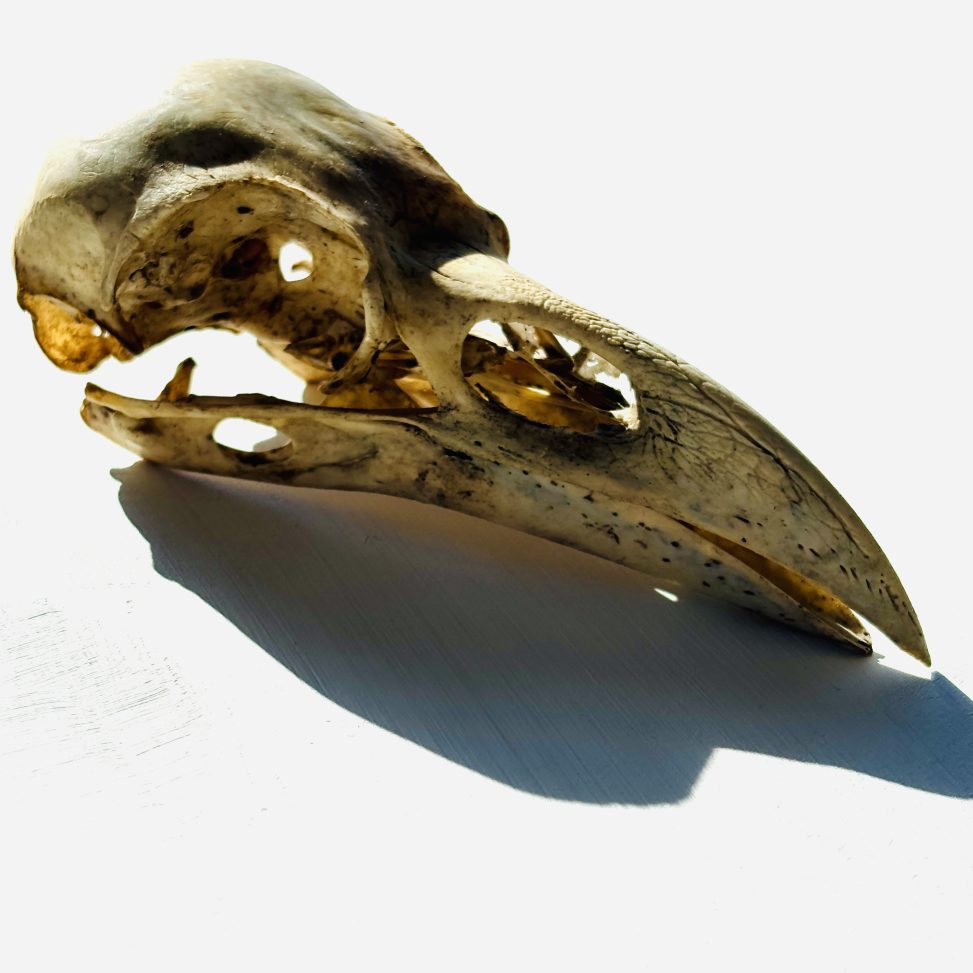
I struggle to suppress a gag reflex. The sight is perfect and disgusting all at once. I think: a rook. I see no grey, so it cannot be a hooded crow. As I spread the feathers further, I see the skull. The beak—massive, shapely, covered in a black ramphotheca. Fringed at the base with black feathers. I want to dance for joy. It is a trophy from a raven.
Millipedes scurry between the feathers. There is no typical swarm of maggot larvae; this intrigues me. I examine the find further. I won’t take anything today. Too much soft tissue. Eyes and brain are still visible in the skull. The bones are coated in decaying meat. It needs a week, maybe two.
As I meditate, the feathers near the belly move. I lift the remains of a wing and again, I must fight my stomach. Tucked safely underneath sit three beautifully grown carrion beetles—Nicrophorus spp. Two with intense orange spots, one slightly more yellow. They are perfect. I take a breath, hold it, and lean over the carcass. Hold on just a moment longer, I tell my stomach, I want to feast my eyes. If such creatures take care of me after death, it will be an honor.
The deficit of larvae is explained. Here, the monopoly on carrion has been taken by the upper class. The beetles compose perfectly with the black feathers. Nature is an artist. A brutal one; she is not afraid to offer sacrifices for her art.
I place the wing back, covering the insects with a blanket. They gathered there for a purpose and deserve discretion. I leave my trophy in the safe hands of professionals.
I return home with a blissful smile on my face.
Glory of the Existence Construction, Digital Photography of a Raven Skull, 2026
The bird died of natural causes.
viscosity